 Umbracolombia
April 2025: the advisory got worse three days after the patch shipped
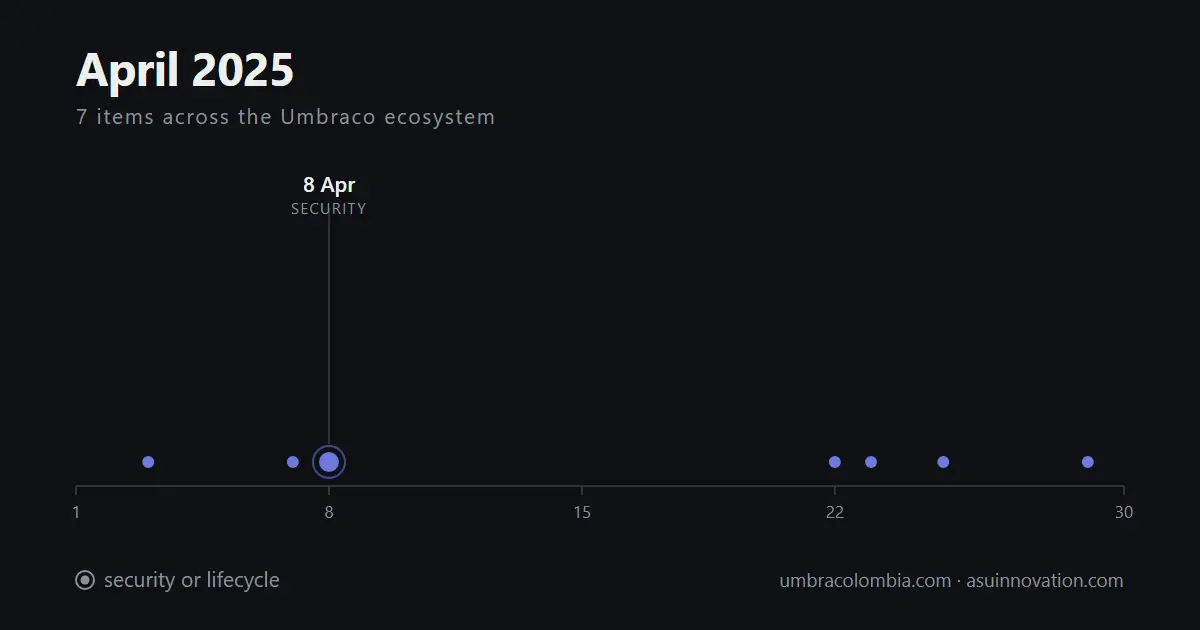
Umbraco shipped a patch for CMS 14 and 15 on 8 April 2025 and described the vulnerability as moderate. On 11 April the same page said high. If you made your upgrade call in those three days, you made it on a number that no longer held.
The advisory was written by Andy Butland on Umbraco's official blog. It covers 14.0.0 through 14.3.3 and 15.0.0 through 15.3.0, with fixes in 14.3.4 and 15.3.1. Exploitation needs an authenticated backoffice session, which is what kept the first rating down. The re-rating came from thinking harder about what a compromised editor account can then do: the update cites the ability to "upload files to non-permitted locations" and the impact that could cause. Umbraco credits Kevin Joensen of Baldur for the disclosure, and says the 8 April patch already resolved the issue in full. Cloud sites on the latest minor were patched automatically.
The prerequisite is the real cost, not the patch
The sentence worth reading twice is the one about availability: patches ship for the latest minor of each supported major only. A site on 14.1 does not get a patch. It gets a minor upgrade, and then a patch. Umbraco frames that as "minimal effort per project", which is fair for one project and misleading for twelve.
This is a policy, not an accident, and it has a consequence that outlives this particular CVE: if your organisation treats minor upgrades as optional maintenance, then your security response time is not the length of a patch window, it is the length of a minor upgrade across your whole estate. April 2025 is where a lot of teams found that out.
Umbraco Cloud picked up a region, non-linear environments and backoffice SSO
Bjarke Berg covered three Cloud changes in one post on Umbraco's own blog, which is worth reading as product marketing for a product Umbraco sells, because that is what it is.
The Central Canada region on Azure soft-launched on 7 April, joining West Europe, US, UK and Australia. That one is a procurement matter rather than an engineering change: it answers the data-residency question that ends conversations with Canadian public sector and healthcare buyers before they start.
Flexible Environments is the one that changes daily work. Berg's framing is that "you're no longer limited to a fixed linear deployment setup" of Development to Staging to Live, so you can add an environment for client approval or a hotfix lane and delete it afterwards. It was in beta when the post went up, with full release expected "within the next week or so" — a vendor timeline, so confirm the current state in the Cloud portal before you plan around it. External Login Providers landed alongside it, giving backoffice SSO against Entra ID, Okta, Google or Auth0.
Sustainability arrived twice in three weeks, and it is performance advice in a new coat
Two of April's Umbraco posts make the same argument. The first carries no individual byline — it is published under the Umbraco name, and the record credits nobody, so nobody is who we credit. It is built around an interview with Andy Eva-Dale, CTO at Tangent, one of Umbraco's external sustainability advisors, whose line is that "sustainability in digital isn't about doing less, it's about doing things smarter". The post puts digital infrastructure at nearly 4% of global carbon emissions, above aviation. That figure comes from the vendor's post and is a contested estimate in the wider literature; treat it as the framing of an argument, not as a measurement you can quote to a board.
The second, by Lasse Fredslund, who the post identifies as Product Owner of Umbraco CMS, is a five-item checklist: WebP and AVIF, lazy loading, ImageSharp, output and partial view caching, minify and bundle, Brotli, a lean theme instead of a bloated starter kit, and green hosting — with Umbraco Cloud on Azure named as the example.
Every item on that list is correct and none of it is new. It is the performance work you should already be doing, re-argued in carbon terms. That is not a criticism of the advice, it is an observation about who the advice is for: if a carbon argument is what finally gets the caching work funded, take the win. But two vendor posts in three weeks on the same theme is positioning, not a product event, and reading it as news will leave you disappointed.
uSync 15.1.6 fixes the imports that break on a fresh boot
v15.1.6 is a patch release for Umbraco v15 from Kevin Jump, who maintains uSync, so this is the record of what changed rather than an assessment of it. The fixes cluster tightly: culture and hostnames not being set on import, tree sort order not applied to new items on a first import, a boot-on-app-starting fix, and block merge corrections. Jump says it "improves import on first boot and startup".
That cluster matters more than a patch number suggests. First-import correctness is exactly the path a freshly provisioned environment takes — a new CI environment, a rebuilt container, a developer onboarding on Monday. Bugs there are the ones you meet at the worst possible moment and misdiagnose as a broken pipeline.
The other two items, and why this month is this thin
The April uProfile is Ishraq Al Fataftah, CTO of ApplezTech in Jordan, twelve years into Umbraco work, who ran some of the first Umbraco sessions in the MENA region and now sits on the Orchestration Advisory Board. Community profile, not technical content, and useful mainly as a map of who is worth following outside the usual northern European circle.
Dennis Adolfi's write-up of an "AI in Action" evening in Gothenburg, where he co-hosted a session on trustworthy AI, is in this harvest because Adolfi is an Umbraco community voice, not because the post says anything about Umbraco. We are counting it honestly rather than dressing it up.
Which brings up the coverage. Five of the seven items here — 71% — come from umbraco.com's own blog, and Umbraco writes about products Umbraco sells. Only two came from anywhere else, and one of those is an event recap. This was a backfilled month, reconstructed from feed archives rather than harvested live, and feeds truncate: the community writing is the first thing that falls off the end of an RSS window. Read the shape of this month as a gap in our net, not as silence in the ecosystem.
What this month was actually about
Strip away the two sustainability posts and the profile, and April 2025 in Umbraco is one security advisory that got worse after the fact, one Cloud feature that changes how teams deploy, and one package release that fixes fresh-environment provisioning.
The advisory is the one that should change something in your organisation, and not because of this vulnerability. Umbraco's patch policy assumes you are already on the latest minor. If you are not, every future advisory costs you an upgrade before it costs you a patch. That is a maintenance posture you choose in advance, on a quiet week, or one that gets chosen for you on a bad one.
Sources
- [Updated] Security Advisory, April 8 , 2025 - Patches for Umbraco CMS are now available — Andy Butland, Umbraco — Official blog
- More Flexibility. More Opportunities. More Umbraco Cloud. — Bjarke Berg, Umbraco — Official blog
- The hidden carbon footprint of digital: what enterprises aren’t measuring - but should be — no author credited on the page, Umbraco — Official blog
- uProfile April 2025 - Ishraq Al Fataftah — Ishraq Al Fataftah, Umbraco — Official blog
- 5 Ways to Run a Leaner, Faster, and Greener CMS — Lasse Fredslund, Umbraco — Official blog
- KevinJump/uSync v15.1.6 - Booting 🥾 improvements. — Kevin Jump (recorded as
KevinJump), uSync releases - AI in Action: What’s next? — Dennis Adolfi