 Umbracolombia
April 2026: the most useful thing Umbraco shipped was two API endpoints
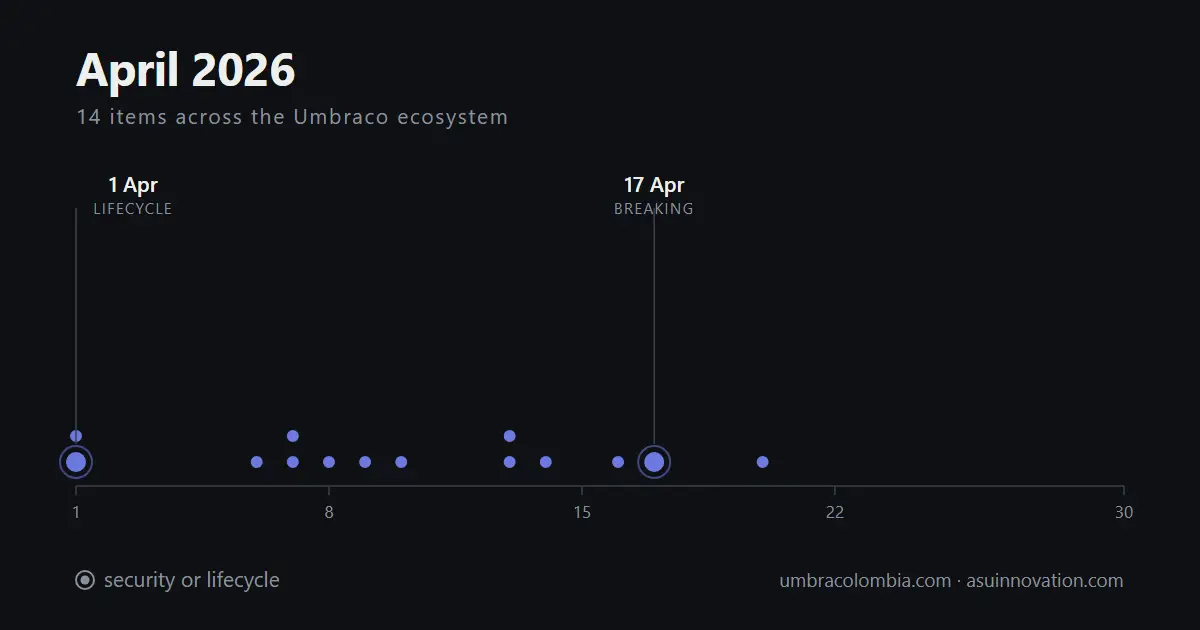
The most useful thing Umbraco shipped in April was not a product. It was a pair of endpoints on the Management API that let a caller ask what shape a property value is supposed to be, before writing it.
That sounds small until you have written an importer. Umbraco's property editors can hold almost anything, and only the editor knows what its own value looks like. Everything outside it guesses. If you have ever discovered a Media Picker's storage format by reading a 400 response, you already understand the problem this fixes.
One disclosure before the rest. Five of the fourteen sources below — 36 per cent — are Matt Brailsford's blog, and Brailsford is building Umbraco AI rather than reviewing it. The record we harvest classifies his site as writing about a product he sells. This month's Umbraco coverage is therefore weighted heavily toward one participant's account of his own work. His posts are the best technical writing available on the subject and they are also not independent. Both things are true.
The point release that changed the contract
Why Umbraco 17.4.0 Is a Big Deal for AI — Matt Brailsford, who works on Umbraco AI
Two new endpoints return JSON Schema: one for a data type's value, one for a document type
composed from all of its properties, with $ref links between them. Each core property editor now
implements a schema provider, so the schema reflects the editor's actual configuration — a Textbox
capped at 250 characters returns maxLength: 250, and a Media Picker returns the nested crop
coordinates and focal-point bounds an LLM has no chance of guessing. Brailsford's description of
the old situation is exact: "There's no contract to inspect, no schema to follow—just trial and
error."
This matters well beyond AI. Any code that writes content through the Management API — a migration, a nightly import, an integration with a PIM — can now validate its payload against a schema instead of discovering the shape empirically. The version number and the linked core PR come from Brailsford's post rather than from a release-notes page, so confirm both against Umbraco's own release notes before you plan a sprint around them.
Umbraco.AI became four things at once
Brailsford also published the month's product coverage: AI Search (semantic vector search built on the new
Umbraco.Cms.Search framework rather than Examine), Prompts (Mustache-style templates that
surface as property actions in the backoffice), and file uploads (drag-and-drop into Copilot, with
text extraction handled by middleware at the IChatClient level so every caller inherits it).
Read the beta labels carefully. He flags that AI Search and the search framework underneath it are both in beta and may shift. That is two moving foundations under one feature. It is a fine thing to prototype against this quarter and a poor thing to put on a client's critical path.
The one to actually read is What We Gained Building Umbraco AI on Microsoft.Extensions.AI and the Microsoft Agent Framework,
because its subject is a design decision rather than a feature list. Every AI capability is an
IChatClient decorator: ten middleware layers, ordered, with guardrails, auditing, file
processing and telemetry each ignorant of the others. Whether or not you ever install Umbraco.AI,
that is a reusable answer to "how do I add cross-cutting behaviour to an LLM call without a god
object".
AI in Umbraco: Control AI Capabilities — Dave Jonker The only reading of the AI layer this month from someone the harvest records no commercial interest for. Jonker's framing is governance: MCP as an API layer the model talks through, actions bounded by permissions, no single-vendor lock-in. At roughly 700 words it is an orientation rather than a deep dive, which is precisely what makes it the right thing to send a nervous client.
What the vendor itself published was a plan
The Agent-Ready CMS: Building Implementation Agent Skills for Umbraco — Phil Whittaker, on Umbraco's own blog Umbraco describes skills that encode implementation best practice — document type structure, Models Builder, block list patterns, Delivery API configuration — and is explicit that the aim is not uniformity: "the goal isn't to create a rigid blueprint that homogenises every Umbraco site." The genuinely useful part is the scope boundary. These skills will cover Umbraco, not Razor tutorials and not the Next.js app consuming the Delivery API.
The rest is intent. Nothing has shipped. A 2,300-word post about work that has started is a roadmap, and the title should say so.
The month's real engineering had nothing to do with AI
uSync v17.3.0 — Kevin Jump, credited on the release as KevinJump There is no 17.1 or 17.2. The release skips two point versions to keep uSync's number aligned with the Umbraco 17.3 dependency it now carries, which will confuse anyone whose CI pins versions by pattern. The substantive change is optional rewriting of HMAC image keys, so rich-text inline images survive a sync between installations that do not share a key. Jump also documents asking an AI to find performance wins and reports what it actually returned: parallelised file reads, and no reduction in database calls at all. An honest negative result, which is rarer than it should be.
How to Bypass Umbraco Cloud Basic Auth for Preview URLs — Paul Seal, Codeshare
The answer to "the client wants to see the unpublished page and does not have a backoffice login".
Seal uses Umbraco Cloud's documented shared-secret feature plus a small middleware that injects the
header for an allow-list of paths held in appsettings.json. Keep that list narrow. You are
punching a hole in a staging site's only protection, and a path prefix is a blunt instrument.
OC.PowerSort 1.2.0 — Owain Williams
Recurring schedules for content sorting: daily, weekly, monthly by date or by ordinal weekday,
with occurrence tracking and invalid-date handling. Two corrections to the record. Our harvest
credited the site handle rather than a person; the page's own credits name Owain Williams as lead
developer, so the byline was wrong and this is the fix. And the post's title says 1.2.0 while its
body and its dotnet add package line say 17.2.0, which is the number that will actually resolve
on NuGet. Williams builds the package, so read it as a release note.
The upgrade argument, made by people who bill for upgrades
Moving to Umbraco 17: Why Now is the Time to Upgrade — Chris Osterhout, Diagram, an agency that implements Umbraco commercially The reasoning is sound even though the author's firm is paid to do the work: 13 is ending, 14 through 16 are short-term support, so 13 to 17 is the only jump that resets the cycle rather than buying a few months. Osterhout is also good on the second-order failure, where a package drops support for your .NET version and routine updates quietly become workarounds. The end-of-life date and the long-term-support designation are lifecycle claims sourced here to an agency blog. Verify them against Umbraco's own lifecycle page before either goes into a client proposal.
Your Site Search is Costing You Pipeline — Jonna Robertson, same agency A services pitch for layering retrieval-augmented search over an existing stack, with a numbered capability list and conversion CTAs in the answer panel. The one idea worth taking is that site search is a conversion surface rather than a utility. There is no implementation detail to take.
Community
Announcing the 2026 Umbraco Awards Nominees — Lasse Fredslund, Umbraco — the shortlist, published by the company that runs the awards. uProfile April 2026 - Will Steed — our record credits Will Steed, who is also the profile's subject; the interviewer is not named in what we harvested. Neither piece changes a decision, and April was thin on community writing that did.
What we're watching
In January the operational knowledge of these platforms was scattered across personal blogs, and we said the risk was that it leaves when those people do. April is the opposite failure. The authoritative account of Umbraco's entire AI layer now sits with one person, who is also the person shipping it, writing about packages in beta that depend on another framework in beta.
That is not a reason to avoid Umbraco.AI. It is a reason to be honest about what you are reading when you evaluate it, and to wait for a second independent account before you commit a client's budget. Meanwhile the schema endpoints in 17.4.0 will outlive this entire product cycle, because they help anything that writes content programmatically, agent or not. If you take one thing from April, take that.
Sources
- Why Umbraco 17.4.0 Is a Big Deal for AI — Matt Brailsford
- Introducing Umbraco AI Search — Matt Brailsford
- Umbraco AI Prompts: Template Syntax and Variables — Matt Brailsford
- File Uploads in Umbraco.AI — Matt Brailsford
- What We Gained Building Umbraco AI on Microsoft.Extensions.AI and the Microsoft Agent Framework — Matt Brailsford
- AI in Umbraco: Control AI Capabilities — Dave Jonker
- The Agent-Ready CMS: Building Implementation Agent Skills for Umbraco — Phil Whittaker, Umbraco
- KevinJump/uSync v17.3.0 - 🎈Floating points release — Kevin Jump
- How to Bypass Umbraco Cloud Basic Auth for Preview URLs — Paul Seal, Codeshare
- OC.PowerSort 1.2.0 — Owain Williams
- Moving to Umbraco 17: Why Now is the Time to Upgrade — Chris Osterhout, Diagram
- Your Site Search is Costing You Pipeline — Jonna Robertson, Diagram
- Announcing the 2026 Umbraco Awards Nominees — Lasse Fredslund, Umbraco
- uProfile April 2026 - Will Steed — Will Steed, Umbraco