 Umbracolombia
August 2025: agents got write access to the backoffice
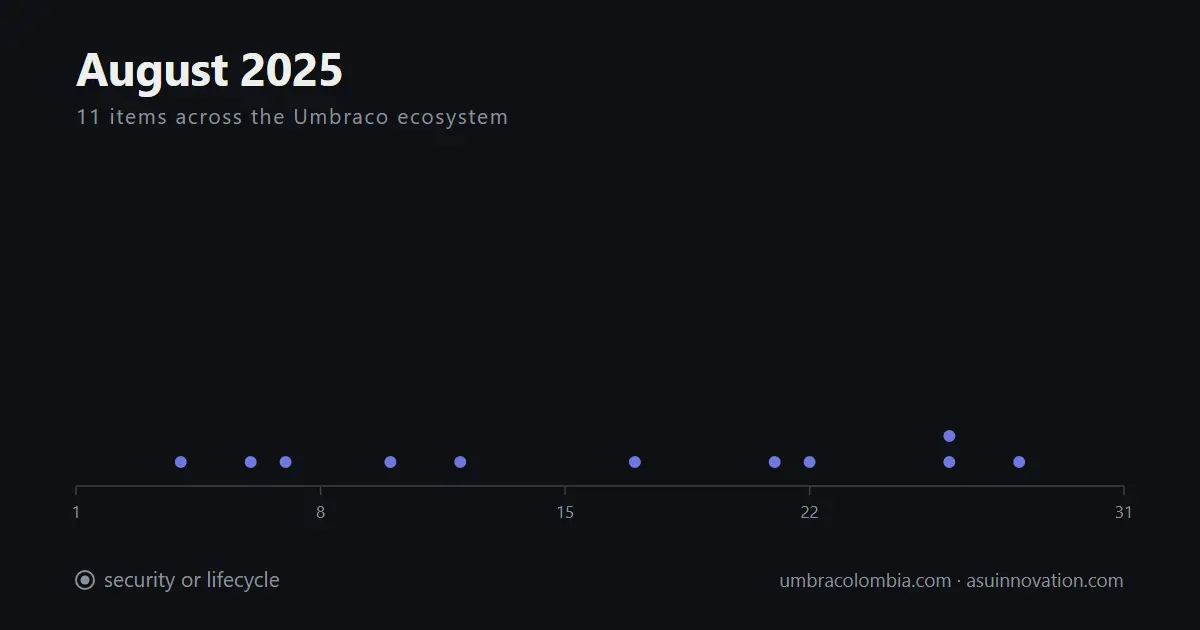
In August 2025 someone posted a video of Cursor creating an Umbraco element type, registering it as an allowed block on the home page's Block Grid, writing the partial view, adding the block to the home page and publishing it. One prompt. The path that costs a developer twenty minutes of clicking is now a paragraph of English, and the only piece published in the whole month that said anything about who should be permitted to walk that path was a patch release note for a sync package.
Four of the eleven Umbraco items in our window are about MCP or AI. Three months after Codegarden that is no longer a curiosity, it is where the ecosystem's attention went.
One prompt built the element type, the Block Grid config, the view and the published page
Endless possibilities in Umbraco with MCP, Cursor and one prompt — the page credits nobody; published at jeroenbreuer.nl Our harvest recorded no author, so we are leaving it empty rather than promoting the site to a person. The blog's own description names Jeroen Breuer, and we know nothing about his commercial relationship to any of the tools involved. Read it for the prompt, which is reproduced in full and is better read as a specification than a demo. It tells the agent to fetch the current Home document before updating it and to include the template object explicitly, which is the step a human forgets at six in the evening and discovers when the page renders naked. The server underneath is the community Umbraco MCP server from Matthew Wise and Phil Whittaker.
Building an MCP Server for Umbraco Commerce — Matt Brailsford Brailsford works on Umbraco Commerce and the proof-of-concept repository sits inside Umbraco's own GitHub organisation, so this is the product side writing about its own product. On those terms it is good work. The integration wraps the management APIs Commerce already had, so day-one coverage is broad with nothing new underneath: daily takings, orders needing attention, search and filter, notes and tags, top sellers, retention. His own framing is that none of it is new and that MCP "makes them quicker and easier to use by putting them behind a simple, conversational interface". True, with one item on that list that is not a read: capturing pending payments moves money. His section on what it cannot do yet is unusually honest for a proof-of-concept.
He also states that Umbraco adopted MCP as the official way to do AI in the platform, following the Codegarden keynote. That is a roadmap claim and it comes to us through a community post rather than through a vendor announcement in our harvest, so treat it as his characterisation and check Umbraco's own post before you build a plan on it.
Lightning talk summary from Fika Fast Talk on Foundry Local — Dennis Adolfi A short write-up of a talk Adolfi hosted in Gothenburg on Microsoft's Foundry Local, which runs models on the device instead of a cloud endpoint. Forty-odd people, a live demo from the terminal and the management SDK, an app answering from embedded local files. It matters more than its length suggests: the usual blocker on putting an agent near client content is that the content cannot leave the building, and local inference is the only answer to that objection that does not start a procurement cycle.
The one release note that talked about access
uSync v16.0.4 — Section moving — Kevin Jump
A MoveToSection setting that lifts the uSync tree into its own backoffice section, so you can
grant uSync access to people who do not have Settings access. Jump then spends more words on the
warning than on the feature: someone with uSync can import changes that would otherwise need
Settings, and moving the tree does not reduce what they can do. "This is a UI not a security
change, and should be treated as that." If your plan was to hand uSync to content leads and take
Settings away from them, that plan is now documented as not working.
uSync v16.0.3 — Sweep and clean — Kevin Jump Four days earlier, and minor by his own description: a typo fix on the add-ons dashboard, UI tidying, and set picking returned to the dashboard after going missing. If you upgraded to v16.0.2 and wondered where set picking went, this is the answer.
Jump wrote that warning because he has spent years watching what an import does to a live site. The people wiring language models into the same management surface published no equivalent paragraph in August, and the capability they are handing out is strictly larger.
Umbraco HQ published two posts, and neither was a product
uProfile August 2025 — UMBRAAD — Mathilde Høst and the UMBRAAD team, on Umbraco's own blog A retrospective on UMBRAAD, the community-run accessibility conference, told largely in the organisers' own words. HQ supplied infrastructure and promotion; the event was run by community members, several of whom came out of the Umbraco 8 backoffice accessibility work. Over a hundred attended live and most sessions are on the community YouTube channel. The practical use is unglamorous: when a public-sector accessibility questionnaire lands, a recorded conference run by the people who fixed the backoffice is a cheaper answer than a paragraph of assurance.
Effective A/B Testing (Part 4) — Niels Christian Laursen, on Umbraco's own blog The fourth part of a vendor series, and better than the genre usually is, because it is about their own two mistakes rather than their product. They stopped tests on early significance, then overcorrected into leaving losing tests running in the hope they would turn. The rule they landed on is that "significant and insignificant results should be treated the same", with sample size and duration fixed before launch. That is a governance point rather than a tooling one.
One caveat on this section. The month was reconstructed from feed archives a year later, so eleven items is a floor rather than a census. Our harvest holds no Umbraco HQ release note for the window, which says something about our coverage and nothing about what shipped. Check the release history before citing the absence.
A workaround that admits, in a code comment, that it is one
Working Around Umbraco's RenderController Async Limitation — Owain.Codes
Signed with the site handle rather than a name; the feed names the blog's owner as Owain Williams.
RenderController.Index() has to be synchronous for the default route to bind, which is awkward
when the page needs a geocoding call and a proximity query before it can render. His fix is a
parameterless Index() that calls the async overload and blocks on .Result, with a comment
saying to delete it if Umbraco ever changes the constraint.
What makes it worth reading is that he does not sell it. He arrived from nested
.GetAwaiter().GetResult() calls, which is worse, and he names the deadlock risk and the lost
scalability himself. That is also the reason to be careful with it: the calling thread stays
blocked, and a location search fanning out to a geocoder plus a database query is exactly the
request you do not want holding a thread under load. He asks for a better approach at the end of
the post, and nobody appears to have given him one.
The ecosystem's memory is one person's side project
UMB.FYI Celebrates it's 100th Issue — Matt Brailsford A hundred weekly issues, 2,128 items, of which 528 were community blog posts and 127 came from HQ, going out to over 700 subscribers. Brailsford started it because social media fragmented and staying current stopped being automatic. We should disclose that we run a pipeline that does a version of the same job, so our appreciation is not disinterested. It is also the most quietly alarming item in the month: the discovery layer for an entire CMS ecosystem is one person's evenings, and the number in that sentence that matters is one.
Adding Scheduled Posts to My GitHub Discussions Powered Blog — Matt Brailsford
Nothing to do with Umbraco, and useful anyway. Two Netlify Functions, a webhook handler that
either publishes or applies a state/scheduled label, and a publisher on a five-minute cron. All
the scheduling state lives in GitHub Discussions labels, so there is no database. If you have ever
been asked for scheduled publishing on a static site and quoted a backend for it, read this first.
I'm a Microsoft MVP in AI Platform — Dennis Adolfi A personal milestone rather than news, included because of where it points. Adolfi's previous MVP awards were in .NET and developer technologies; this one is in AI Platform, in the Trustworthy AI area, and he notes he is one of six in Sweden in the AI category. The same people who were writing about Umbraco packages two years ago are now recognised for AI security work. That is the month's direction again, in a form that has nothing to do with a product launch.
What August was actually about
The Umbraco community spent August demonstrating that a model can author schema, register it, write the view for it and publish content using it, and spent essentially no words on the authorisation model underneath that. An MCP server inherits whatever credentials you hand it, and the Umbraco management API cannot tell a developer typing from a model that misread an instruction. Neither can your audit log, which will show the API user either way.
Kevin Jump wrote the paragraph that the rest of the ecosystem still owes its users: here is what this capability actually grants, regardless of which menu it appears under, and moving the menu does not change it. That paragraph belongs in the README of every MCP integration in this ecosystem. In August 2025 it was in none of them, and a proof-of-concept that can capture payments had already shipped.
Sources
- Endless possibilities in Umbraco with MCP, Cursor and one prompt — no byline on the page, jeroenbreuer.nl
- Building an MCP Server for Umbraco Commerce — Matt Brailsford
- Lightning talk summary from Fika Fast Talk on Foundry Local — Dennis Adolfi
- KevinJump/uSync v16.0.4 - Section moving — Kevin Jump
- KevinJump/uSync v16.0.3 - Sweep and clean — Kevin Jump
- uProfile August 2025 - UMBRAAD — Mathilde Høst and the UMBRAAD team, Umbraco
- Effective A/B Testing (Part 4) — Niels Christian Laursen, Umbraco
- Working Around Umbraco's RenderController Async Limitation — Owain.Codes
- UMB.FYI Celebrates it's 100th Issue — Matt Brailsford
- Adding Scheduled Posts to My GitHub Discussions Powered Blog — Matt Brailsford
- I'm a Microsoft MVP in AI Platform — Dennis Adolfi