 Umbracolombia
August 2026: the roadmap talk was AI, the useful writing was build tooling
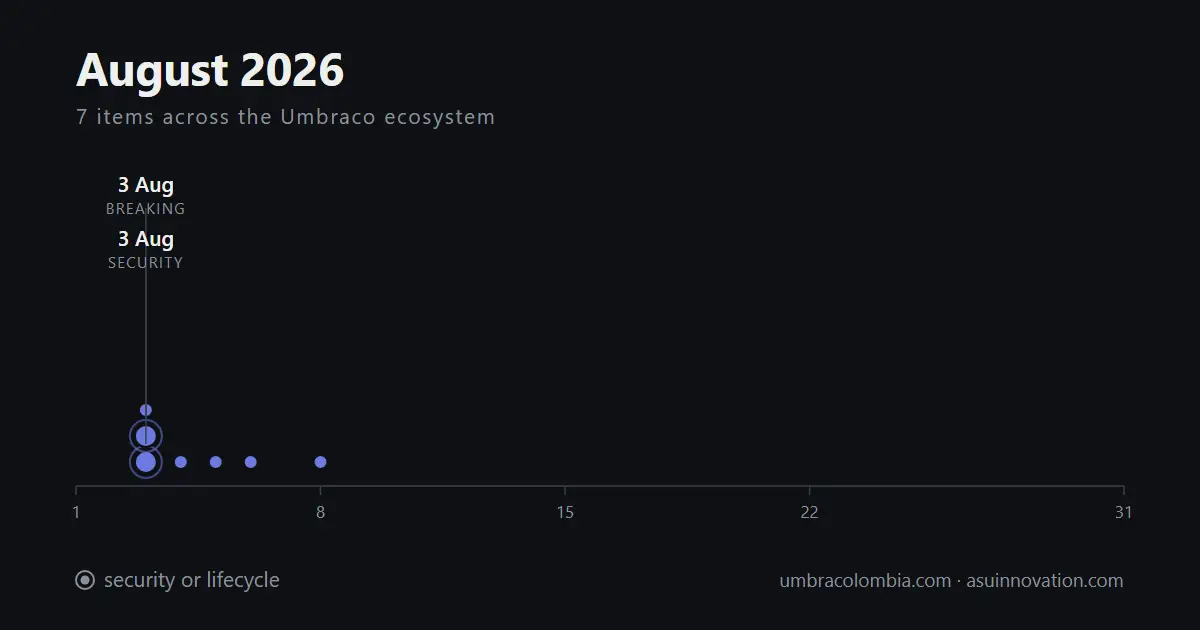
Two conversations were running in Umbraco during the first ten days of August and they were not about the same thing. On the conference stage the subject was AI and a cloud roadmap. In the writing that will actually save somebody a weekend, the subject was a bundler, a load balancer, an operating system and a JavaScript framework release.
Before anything else: this covers the first ten days of August, not the month. Our corpus stops at 10 August 2026, so what follows is a ten-day sample. Seven items cleared the bar and seven is what you get here. Padding a thin window until it looks like a full month is how a roundup stops being worth anyone's time.
The backoffice is a front-end build problem now
How to build an Umbraco 17 dashboard with Vite — Nathaniel Grantham-Knight, Skrift — the Umbraco magazine A dashboard used to be something you added. It is now something you build: a bundler config, a manifest and a build step that has to survive your deployment pipeline. If anyone on your team still estimates "small backoffice dashboard" as an afternoon, hand them this first and re-estimate afterwards.
RazorKit: component-driven Umbraco design systems — John Ennew, Manifesto — Thinking The case for treating Razor views as a component system rather than a drawer of partials nobody owns. Manifesto are a digital agency that builds Umbraco sites commercially, so this is a shop describing its own method rather than a neutral survey. That does not make the method wrong, and if your view layer has drifted, it is a method worth stealing from.
The boxes underneath, which is where projects actually break
Preparing your site and packages for load balancing — Jesper Mayntzhusen, Skrift — the Umbraco magazine The most valuable thing in this ten-day window. Note the word "packages" in the title, because that is the failure mode: the site scales fine and some package in the tree quietly assumed one server, one file system, one scheduled task. You find that out on the day you add the second instance, usually under load, usually on someone else's deadline. Read this before that day.
Setting up Windows Server 2025 for Umbraco — credited to Nevitech IT Solutions Ltd; the record names no individual author (Nevitech, Justin Neville's firm) Hosting setup notes age faster than almost anything else we link, and the ones written by people running the boxes are better than the ones written from documentation. Nevitech sell IT services, so a setup guide from them is useful information and also a shop window. Both things are true at once and neither disqualifies it.
Next.js v16.3.0 — timneutkens (GitHub handle), Next.js releases Released 3 August. This is here because a headless Umbraco front end is usually a Next.js application, which makes Vercel's release cadence part of your risk surface whether you track it or not. Our harvest flagged this one under security. We have not read the notes, so we are not going to characterise a fix we cannot cite. Open them yourself before you assume a minor version bump is routine.
The roadmap coverage, and why to verify it before quoting it
Three of the seven items here come from one agency's blog, the Thinking section at Manifesto. That is a lot of one voice in a small sample and it deserves saying plainly: Manifesto build Umbraco sites commercially, their conference coverage and their technical posts are part of how they sell, and in a ten-day window this quiet, one agency's editorial calendar substantially shapes what the period looks like from the outside.
Umbraco Codegarden day 1: AI, Elements, awards — Richard Howell, Manifesto — Thinking Day-one coverage from an attendee. Useful for the texture of what was said on stage, and it is worth being precise about what it is: an agency write-up, not an Umbraco announcement.
What is an Umbraco MVP, plus future AI and cloud roadmap insights — the page credits no individual author; published by Manifesto — Thinking Same caveat with more weight behind it. Roadmap material with no named author, relayed by a commercial partner rather than by the vendor, is not a thing to build a client deck or a budget line on. If a date or a feature commitment from either of these posts matters to a decision you are about to make, confirm it against Umbraco's own material first.
What we would actually do with this
The gap between the two halves of this list is the part worth arguing about. The roadmap conversation in Umbraco right now is AI and cloud. The writing practitioners produced in the same ten days was about a bundler, a load balancer, an operating system and a framework release.
That is not a complaint about AI being on the roadmap. It is an observation about where the risk sits. No project we have seen failed this year because its CMS lacked an AI feature. Several have gone badly because the second web server did not behave like the first one, or because a "straightforward" backoffice extension turned out to need a front-end toolchain nobody had budgeted for.
So if there is room for exactly one piece of homework off this list before September, make it the load-balancing one. And treat this whole post as what it is: ten days, in a month when much of Umbraco's northern-European centre of gravity is on holiday. A quiet ten days is not evidence of a quiet ecosystem, and we would rather say that than dress up seven links as a verdict.
Sources
- How to Build an Umbraco 17 Dashboard with Vite — Nathaniel Grantham-Knight, Skrift — the Umbraco magazine
- RazorKit: component-driven Umbraco design systems — John Ennew, Manifesto — Thinking
- Preparing your site and packages for load balancing — Jesper Mayntzhusen, Skrift — the Umbraco magazine
- Setting up Windows Server 2025 for Umbraco — Nevitech IT Solutions Ltd (no individual author credited), Nevitech
- Next.js v16.3.0 — timneutkens, Next.js releases
- Umbraco Codegarden day 1: AI, Elements, awards — Richard Howell, Manifesto — Thinking
- What is an Umbraco MVP plus future AI cloud roadmap insights — no individual author credited, Manifesto — Thinking