 Umbracolombia
January 2026: nine Umbraco items all month, and the one that matters is a uSync patch
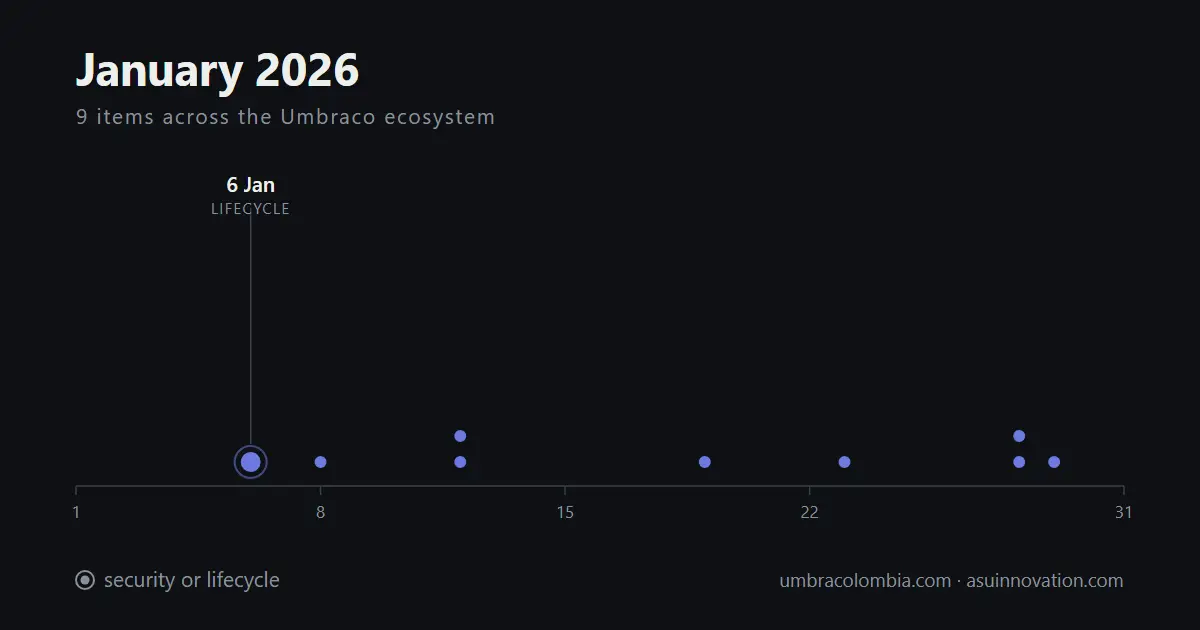
Thirty-one days of harvesting produced 39 articles across both CMSs we follow, and 9 of them were Umbraco. Not one is a vendor release, a security advisory or an end-of-support date. This was a thin month and there is no point dressing it up.
One item on the list will cost you a day if you miss it, and it did not come from Umbraco.
uSync 17.0.2 fixes a defect in the v13 upgrade path
KevinJump/uSync v17.0.2 - Tab Clash / Picker Migrations Fix — Kevin Jump, signed on the release with his GitHub handle, KevinJump
The release note is short and the middle line is the one that matters. Media and content pickers
coming across from v13 lost their StartNodeId and filter values in migration (issue #870), and
an alias lookup was matching partially rather than exactly (issue #862). The release title
attributes the tab name clashes to that second one. Kevin Jump describes it as a patch fixing
issues with "tab name clashes and migrated media and content pickers".
If you are part-way through a v13 to v17 move and your editors are reporting that a media picker suddenly lets them browse the whole tree, this is your explanation. Two things follow. First, patch before you re-run the import, not after, because a partial migration with the wrong start nodes is worse than no migration. Second, this is a source-repo release note rather than a vendor advisory, and there was no vendor channel carrying it. That is worth sitting with for a moment.
A first-time contributor, stephlane, landed the third change in the release. Small, but the kind of detail that tells you the package is alive.
Umbraco Compose got its first hands-on writeup, and Umbraco did not write it
Released: Umbraco Compose example project — not credited on the page
The page carries no byline. Our harvest recorded none and the post itself credits nobody, so we
are not going to substitute the site for a person. It sits on jeroenbreuer.nl and the repository
it links to lives under the jbreuer GitHub account, which is as close to attribution as the
page gets. We also do not know what relationship, commercial or otherwise, the author has with
Compose, so read it as an enthusiast's tour rather than an independent evaluation.
Read it anyway. It is a C# client library plus a CLI that walks the full loop: create an
environment, create collections, define schemas, bulk-ingest, then query. The interesting part is
the last command. Querying articles returns the referenced products already expanded and nested,
using $ref and $delivery.refCollection in the schema, which removes the client-side matching
step that every headless project ends up writing by hand.
That is the clearest picture of Compose's actual shape published in January, and it came from outside the company that sells it. If you are evaluating Compose for a client this quarter, this repository will tell you more in twenty minutes than the product page will.
Crops through the Delivery API, and where the answer actually came from
Using Umbraco Media Picker Crops with Next.js — Nathaniel Nunes
@Url.GetCropUrl(...) in a Razor template is one line. Getting the same crop out of the Content
Delivery API and into next/image is not, and this is the first writeup we have seen that
handles it end to end on Umbraco 17. The setup leans on the community package
Umbraco.Community.DeliveryApiExtensions, which pushes type information into the Swagger schema
so you can generate TypeScript models that match your document types instead of hand-writing
them.
Nunes credits the underlying approach to Sebastian Pierre and Balázs Kerper on the Umbraco Discord. That is the honest version of how most of this knowledge moves, and it is also the problem: a Discord message is not searchable, not versioned, and not there in eighteen months. He did the useful thing by writing it down.
Tooling, and an argument aimed at the person who signs off the upgrade
Introducing Package Script Writer CLI Tool — Paul Seal, Codeshare
The tool that generates the dotnet new incantation for a fresh Umbraco solution now runs in the
terminal, at 1.0.1. Paul Seal, who wrote the tool, says it needs .NET 10; install with
dotnet tool install --global packagescriptwriter.cli, then run psw. Saved templates are the
real win, because your team's standard package set stops being tribal knowledge. It also ships a
table of Umbraco release and end-of-life dates, which is a reasonable thing to have one keystroke
away rather than in a browser tab you closed.
Umbraco 17 for Marketeers: Key Updates & Benefits — Dave Jonker
Jonker opens by admitting that "most Umbraco release notes are written by developers for other developers", and then writes the version that a marketing lead can read. His argument is that v17 has no headline feature and that the case for it is cumulative: a faster backoffice, a steadier editing experience, fewer surprises. Those are his impressions rather than published benchmarks, and he is a community voice rather than the vendor, so treat them as one practitioner's read and confirm against your own instance before you put them in a proposal. As a document to forward to the client who keeps asking why the upgrade matters, it does a job nothing official does.
Three of the nine came from umbraco.com, and only one was product news
A third of this month's Umbraco material is the vendor publishing about itself, which is worth naming rather than hiding in a sources list.
Umbraco's product organisation achieves ISO 27001 certification — Filip Bech-Larsen, Umbraco
This is Umbraco writing about Umbraco, so read it as an announcement and not as analysis. The scope matters more than the headline: the post states that the certification "applies specifically to Umbraco's product organisation", meaning the teams and processes that build and operate the products. Keep that distinction straight when a client's security questionnaire asks what is covered, because answering "Umbraco is ISO 27001 certified" is a broader claim than the post makes.
The other two vendor items are New Year, New Perspectives: The Importance of Togetherness — Allen Smith, Umbraco — and uProfile January 2026 - Adam Prendergast — Adam Prendergast, Umbraco. Community and culture writing, both on the vendor's blog. Neither changes a technical decision, and we are listing them because they were in the month rather than because they were the month.
Underneath the CMS
The Grand Mystery of the Missing 18 Bytes — Steve Gordon
Umbraco is ASP.NET Core, and Gordon's account of chasing a discrepancy between what a benchmark reported and what a memory profiler reported is the best writing in this month's set. Not actionable on Monday. Useful the next time your own numbers disagree with each other and you are tempted to trust the tool over the arithmetic.
What we would actually do about January
Put the uSync release feed somewhere your team reads. In January it was the only source that told you about a defect in your own upgrade path, and it beat every vendor channel to it because there was no vendor channel. If your upgrade monitoring is "we check the Umbraco blog", this month is the evidence that it does not work.
The second thing is harder to act on. Compose is the newest thing in the portfolio, and the most useful January document about it is a community repository from someone the page does not even name. A product whose best documentation is written by volunteers is a product that will be adopted slowly and blamed loudly when it goes wrong.
One honest caveat: nine items is a statement about our harvest as much as about Umbraco. A thin month across nine sources is not proof that a platform went quiet, and the right response to a persistently thin vendor is more sources, not lower standards for what counts as news. We are working on the first. February, for what it is worth, was not thin at all.
Sources
- Introducing Package Script Writer CLI Tool — Paul Seal, Codeshare
- Umbraco 17 for Marketeers: Key Updates & Benefits — Dave Jonker, Dynamic Dave
- KevinJump/uSync v17.0.2 - Tab Clash / Picker Migrations Fix — Kevin Jump (credited as KevinJump), uSync releases
- The Grand Mystery of the Missing 18 Bytes — Steve Gordon, Code with Steve
- New Year, New Perspectives: The Importance of Togetherness — Allen Smith, Umbraco official blog
- Umbraco's product organisation achieves ISO 27001 certification — Filip Bech-Larsen, Umbraco official blog
- Using Umbraco Media Picker Crops with Next.js — Nathaniel Nunes
- uProfile January 2026 - Adam Prendergast — Adam Prendergast, Umbraco official blog
- Released: Umbraco Compose example project — not credited on the page (jeroenbreuer.nl)