 Umbracolombia
November 2025: Umbraco 17 LTS shipped, and the packages were ready the same day
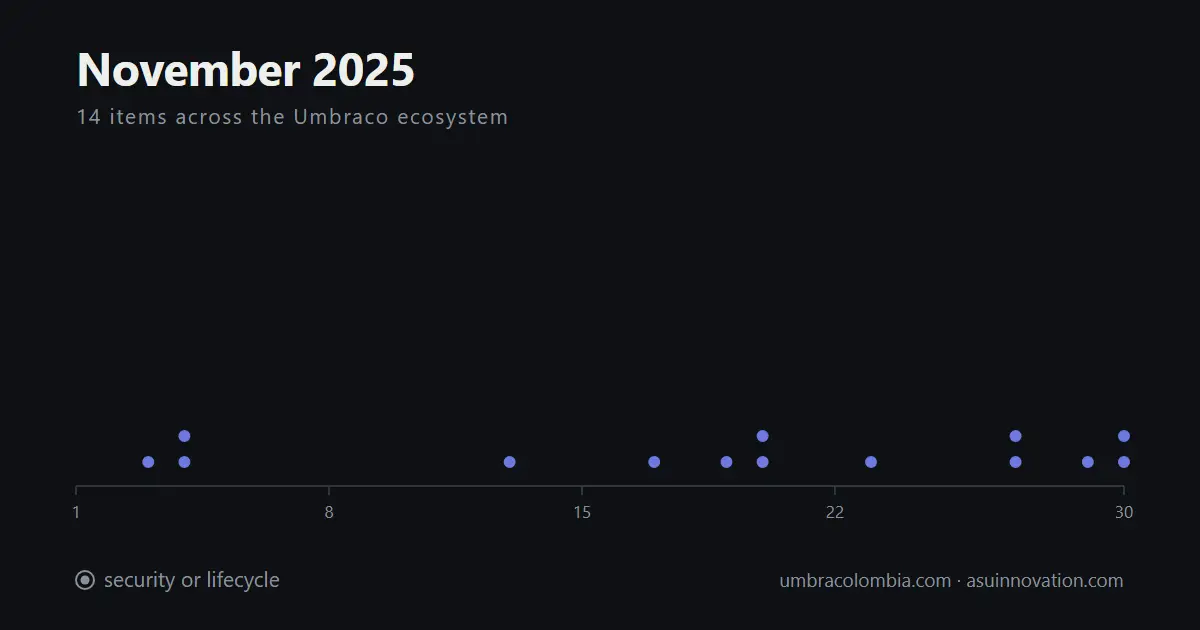
Umbraco 17 arrived on 27 November as the next long-term-supported version, built on .NET 10 LTS, promising what the release post by Bolette Kern on Umbraco's own blog describes as "3 years of stability as a Long-Term Supported version". If you are still on 13, November is the month your upgrade stopped being a conversation for next year.
The more interesting fact is what landed beside it. uSync 17.0.0 and Clean Starter Kit v7 both shipped on the same day as the CMS. Anyone who waited out the Umbraco 14 cycle knows how rare that is.
Seventeen closes the Bellissima arc instead of opening a new one
The vendor's framing of 17 is a milestone rather than a feature drop, and for once the framing is honest. Kern's post positions it as the point where the backoffice rewrite that started in 14 is finished: feature parity with 13, an extension surface that has settled, and a package ecosystem that has caught up. The CMS-level additions are load balancing for the backoffice and consistent date handling. Both are the kind of thing you notice in production and nowhere else.
Dave Jonker's read on Dynamic Dave is the useful counterweight, because he is not selling anything. He calls 17 "a 'quality of life' release, and honestly, those end up being the ones people stick with", and points at dependency injection that finally behaves like plain ASP.NET Core, tidier generated models, and a Delivery API that has stopped surprising people. That is the correct description and it is also the commercial problem with this release: there is nothing in it to demo. The argument for upgrading is made of support windows and fewer weird edges, which is a much harder sell to a client than a new editor.
The ecosystem was ready on day one, which is the actual news
uSync 17.0.0 went out on 27 November, the same day as the CMS, described by Kevin Jump as containing "all the goodies and tweaks required to get things syncing on the shiny new LTS version". That did not happen by luck. The 17.0.0-rc2 release two weeks earlier was built against Umbraco's own rc2, and the final changelog shows him chasing rc3 and rc4 including a breaking Swashbuckle change. Also in there: background processing, an RTE block import fix, the v13 client code removed, and Newtonsoft dropped from the history module.
Paul Seal's Clean Start Kit v7 on Codeshare shipped the same Thursday, targeting 17 outright rather than multi-targeting. His post also carries the lifecycle line most teams will actually want: that Umbraco 13 "has now entered the security phase and will no longer receive new features". Seal is a community maintainer rather than the vendor, so confirm that against Umbraco's own lifecycle page before you put a date in a client's budget, but it matches the shape of the LTS cadence.
The AI items, and the one that shows a method
Five of the fourteen items in this month's harvest, 36% of them, come from umbraco.com's own blog, and three of those five are about AI. Read the section with that in mind.
The substantial one is the Umbraco CMS Developer MCP for Umbraco 16, written by Phil Whittaker for Umbraco. It moves from roughly 200 tools in beta to 330+ across 36 endpoint groups, close to full parity with the Management API, with permission elevation deliberately left out. It is documented on docs.umbraco.com rather than in a README, which is the detail that tells you it is meant to be supported, and an Editor MCP is promised next. The post targets 16; a note added later says a 17 build followed.
Don't outsource your AI strategy by Filip Bech-Larsen is positioning, not analysis, and it closes with "Umbraco. Your platform. Your AI. Your choice." The argument, that a CMS should be model-agnostic rather than shipping a bundled assistant, is one we happen to agree with. It is still the company that sells the platform explaining why its competitors' approach is a trap. Niels Christian Laursen's webhooks and Zapier walkthrough, also on Umbraco's blog, is the practical companion: form submit to CRM without a bespoke integration.
The one to copy is Dennis Adolfi's post on generating ADRs with an AI agent.
He points an agent at an existing Umbraco codebase with Nygard's template and an index file, then
makes it continuous with a standing instruction in agents.md: "Always create an ADR when
changes are made to the codebase that affect the overall architecture." That is a reproducible
technique with a named failure mode it fixes, which is more than most AI posts manage.
The month's uncomfortable post
On 3 November, Owain Williams, writing as Owain.Codes, counted the photos posted for Umbraco Tees Day. He found two, and one of them was his. He also notes that "the Umbraco Discord has gone quiet, mostly just people saying 'morning' and not much else".
The follow-up a day later collects what people replied, and he says openly that he used ChatGPT to summarise the thread. The themes: conversation split across Bluesky, Mastodon, LinkedIn and Discord with no centre; a shift in tone from founder-led to corporate; the end of the regional training courses that used to create local networks; and newcomers who wear the merch without knowing the traditions exist. Two posts by one person are not a survey. They are still the only item this month that asks a question the release notes cannot answer.
Also worth the time
Paul Seal's second post, on running a local HTTPS site inside a GitHub Action, is valuable because he shows the two approaches that failed before the one that worked. His first attempt to trust the dev certificate programmatically ended with "the workflow hung indefinitely", waiting on a confirmation dialog that never comes in CI. If you are automating Management API calls against a running Umbraco instance, read it before you write the workflow.
Georgina Bidder's account of building her first package for 24 Days in Umbraco is a Lorem Ipsum generator for the rich text editor, built at the Umbraco Spark hackathon and honest about the TinyMCE learning curve. Our harvest recorded her credit as a posting line dated 1 December rather than as a clean byline, while the feed placed the piece on 30 November; the author is Georgina Bidder either way.
Finally, Mats Persson announced on Umbraco's blog that the company is expanding into Australia and New Zealand, with Emmanuel Tissera as Head of APAC and, per the same post, "follow the sun" support coverage from 1 February 2026. Commercial news, but the support-hours change is the part that shows up in an SLA.
What we would actually do about it
One caveat on the numbers above. This month was reconstructed from feed archives rather than harvested live, so fourteen items is what survived in the feeds, not a measurement of how busy Umbraco's November was. Things published without a durable feed entry are missing and we have no way to count them.
The opinion worth arguing with is this: the LTS badge measures the vendor's commitment, not the ecosystem's. Three years of Umbraco 17 support is a promise from a company with a support contract behind it. Day-one uSync and a day-one starter kit are a promise from two individuals who happened to track the release candidates on their own time. In November those two promises arrived together and the upgrade path looked seamless. Plan the migration around the vendor's dates, and budget the package dependencies as though their maintainers might have a busy quarter, because that is the risk you are actually carrying. It is also, less comfortably, the same month somebody counted two Tees Day photos.
Sources
- Umbraco 17 LTS: Final Release — Bolette Kern, Umbraco Official blog
- Don't outsource your AI strategy — Filip Bech-Larsen, Umbraco Official blog
- Umbraco CMS Developer MCP for Umbraco 16 — Phil Whittaker, Umbraco Official blog
- Automate Your Lead Flow in Umbraco with Webhooks and Zapier — Niels Christian Laursen, Umbraco Official blog
- Growing Together: Umbraco Expands into Australia and New Zealand — Mats Persson, Umbraco Official blog
- What's New in Umbraco 17? Key Features & Insights — Dave Jonker, Dynamic Dave
- KevinJump/uSync v17.0.0 : Thanks be to Seventeen — Kevin Jump, uSync releases
- KevinJump/uSync v17.0.0-rc2 - closing in. — Kevin Jump, uSync releases
- Clean Start Kit v7 is out now for Umbraco 17 — Paul Seal, Codeshare
- How to Run a Local HTTPS Site Inside a GitHub Action Without the Dev Certificate Trust Issue — Paul Seal, Codeshare
- AI generated Architecture Decision Records (ADR) — Dennis Adolfi
- Has the Umbraco Community lost it's Spark? — Owain Williams (Owain.Codes)
- When the Umbraco Community responds. — Owain Williams (Owain.Codes)
- Building My First Umbraco Package: Creating the Lorem Ipsum Generator. — Georgina Bidder, 24 Days in Umbraco