 Umbracolombia
October 2025: Umbraco 17 went to beta and uSync closed the v16 line
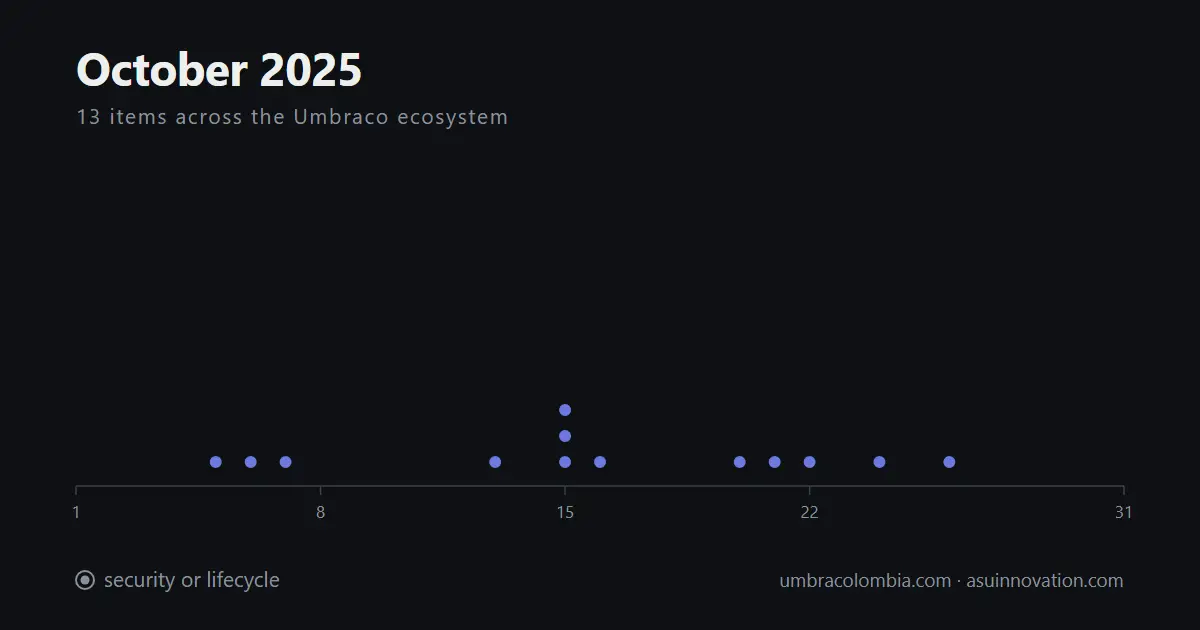
If you run an Umbraco 16 site, the most consequential sentence published in October was not on umbraco.com. It sat at the foot of a GitHub release note, where Kevin Jump called uSync 16.1.0 "the last 'feature' release of uSync for Umbraco v16". Everything after it on the v16 line is fixes.
That is the maintainer of the tool most of us deploy with telling you where the road ends, six weeks before the vendor's next long-term release arrives.
Umbraco 17 arrived as a beta, and the beta itself is the news
On 15 October Umbraco published the Umbraco 17 beta. Bolette Kern, writing on the company's own blog about the company's own release, set out a process change alongside it: from 17 onward "every major version of Umbraco will include a beta six weeks before launch". The release candidate follows roughly four weeks out, and the final release was set for 27 November.
The reasoning is more candid than release posts usually manage. By Umbraco's own account the old release-candidate label had been absorbing last-minute changes, which made the name misleading. Beta now means feature development is done and only bug fixes land; RC means regression fixes only. If you maintain a package, or you test a client site against pre-release Umbraco, that moves when the work gets scheduled, not just what it is called.
The number to scope in a 13-to-17 jump is not the CMS
Umbraco 17 is the new LTS, and the company says plainly that many teams will arrive directly from 13. That path crosses Bellissima, the backoffice rewrite that replaced AngularJS with Web Components and introduced the Management API in v14. The post does not soft-pedal the cost: custom backoffice extensions are named as the most significant variable in the upgrade, and the size of the rework scales with how many you have.
Specifics worth putting into an estimate, all from the vendor's own list. SendingContentNotification
has been split into three narrower extension points (Property Preset Values, Content Type Create
Filter, Property Level UI Permissions), which is a better design and still a rewrite for anyone
who leaned on the old notification. Backoffice tours and the block grid example configuration are
not coming back. The TinyMCE-to-TipTap replacement that landed in 16 is on the path whether or
not you ever stopped at 16. New in 17 itself: .NET 10 support, load balancing for the backoffice,
and UTC-consistent date handling with a time-zone-aware date editor.
An LTS-to-LTS upgrade rolls up two years of work, so it is bigger than a six-month hop by construction. Umbraco is up front about that. What the post cannot tell you is your own extension count, and that is the number the estimate lives or dies on.
uSync shipped four times in eleven days, and the order matters
Jump published v16.0.7 on 6 October, v16.0.8 on the 7th, v16.1.0 on the 15th, and v17.0.0-beta on the 16th. Read in sequence it is a maintainer clearing the decks: allocation trims and a self-referencing-node fix, then startup-import and ordering fixes, then a feature release that adds merging of multiple items into single files and better reporting on BlockList and Grid merges. Then the v17 port, one day after Umbraco's own beta, with Jump noting it "contains no new features other than changes to make the package build and run on Umbraco v17" and full v17 coverage still to be worked through.
If your deployments run through uSync, that is your calendar rather than a changelog. The v16 feature line is closed, the v17 line is a port that has not yet caught up with what 17 adds, and the gap between those two facts is where a schema deployment will surprise you.
Umbraco's own blog argued against the composable wave
On 24 October Filip Bech-Larsen published Composable Regrets on umbraco.com. This is a vendor making an architectural argument on its own channel, and the argument happens to favour the shape of product it sells, so read it as advocacy. It is still an accurate description of what the first composable wave cost the teams that bought it: enterprises turning into de facto system integrators, a complexity tax assembled from licensing plus integration plus maintenance, and an end experience that arrives visibly stitched together. His formulation, "composability without clarity is chaos", is the line people will repeat.
Not neutral analysis. Also not wrong.
The rest of the month was community writing, and it is worth saying so
This is a backfilled month, reconstructed from feed archives rather than a live crawl, so treat the volume as a floor and not a census. The harvest returned 84 items across both CMSs for October; 13 were Umbraco, and we cited all 13. Four of those are uSync release notes and four are from umbraco.com, so two publishers account for eight of thirteen items.
The strongest of the rest is SPECKL from Matt Brailsford, an attempt to sit between vibe coding and full spec-driven development on the principle "Humans build. AI assists. Specs define the boundaries." It ships as a spec template plus a set of Claude Code commands. Brailsford builds Umbraco Commerce, and the worked example in the post is a refund-reasons spec for it, so the example is a product author's rather than a disinterested one. The technique stands on its own regardless. He also marked UMB.FYI's second birthday with a Pulse Check report on the community's year.
Beyond that: Allen Smith's guide to getting involved in the community and the October uProfile with Helen Chaplin of Cantarus, both on umbraco.com. Dennis Adolfi posted three times, on moving to the Azure AI Foundry MVP category, on a lecture about sustainable technology and responsible AI to 200 students at Medieinstitutet, and on Umbracokalaset 2025 in Stockholm. None of it changes what you do on Monday, and none of it claims to.
What we would act on
If you are on 16, stop treating 16.1.0 as a waypoint. It is the ceiling, and the decision to move to 17 has effectively been made for you by the tooling. If you are on 13, October's beta is the first honest chance to measure the extension rework against a build that is feature-complete, and measuring it in November is cheaper than discovering it in a migration window.
The uncomfortable part is the shape of the month. The most operationally useful document published for Umbraco in October was a GitHub release note, written by one person maintaining the package the rest of the ecosystem deploys with. The vendor's beta post was good and thorough; the release note is the one that changed a plan. An ecosystem where the deployment tool's lifecycle gets announced in a changelog footer rather than a roadmap is running on a favour, and a favour is not a support contract.
Sources
- Umbraco 17: Ready, Reliable, and Less Scary than It Sounds — Bolette Kern, Umbraco official blog
- Composable Regrets: Lessons From the First Wave — Filip Bech-Larsen, Umbraco official blog
- KevinJump/uSync v17.0.0-beta - Bee tarrr. — Kevin Jump, uSync releases
- KevinJump/uSync v16.1.0 - Block and File merging. — Kevin Jump, uSync releases
- KevinJump/uSync v16.0.8 - niggles 😠 — Kevin Jump, uSync releases
- KevinJump/uSync v16.0.7 - Templates, Ordering and fast tables. — Kevin Jump, uSync releases
- SPECKL: Testing a Human-First Approach to AI-Assisted Development — Matt Brailsford
- UMB.FYI Celebrates it's 2nd Birthday with a Pulse Check — Matt Brailsford
- Finding the Right Path: Getting More Involved in the Umbraco Community — Allen Smith, Umbraco official blog
- uProfile October 2025 - Helen Chaplin — Helen Chaplin, Umbraco official blog
- I´m a Microsoft MVP in Azure AI Foundry — Dennis Adolfi
- I did a lecture about Sustainable Technology and Responsible AI at Medieinstitutet — Dennis Adolfi
- Umbracokalaset 2025 — Dennis Adolfi